
Everything I Know About Boundaries I Learned from my Cat by Carson McCain, LPC
I first encountered the word “boundaries” in my own therapy.
Picture if you will, a sweet 20-year-old, straight-A theatre student. She’s intensely determined to squeeze every bit of learning she can from the program she’s very lucky to be attending. She can’t say no (particularly to authority figures). She knows something isn’t quite right when she finds that she cannot open her email without bursting into panicked tears. She will be surprised when her therapist tells her she maybe, possibly, could have a bit of anxiety.
 The idea of saying ‘no’ in this season of my life was so distressing because I could not imagine surviving someone else’s disappointment in me.
Hence the need for boundaries.
Way back in 2012, this was not a word I had ever heard before. Now, you could throw a rock and hear someone talking about the importance of setting boundaries.
I now like to think of the concept like this:
In her book Set Boundaries, Find Peace, Nedra Glover Tawwab defines boundaries as “expectations and needs that help you feel safe and comfortable in your relationships.”
When you are clear with others about expectations and clear with yourself around your own needs, you can keep yourself safe by respecting the limitations you have already agreed on within yourself. This is the difference between a boundary and a rule. Boundaries are for you to follow, while rules are for others. A rule can be violated again and again. A boundary may be violated, but it is your work to know and take care of your own needs. I like to think of boundaries as knowing where I end and another begins.
Here’s an example from pop culture to try to be more clear – Jonah Hill made headlines for telling his ex-girlfriend that she wasn’t allowed to post specific photos because that was his ‘boundary.’ I don’t know their relationship at all, but from the outside this would seem to me at the least a ‘rule’ and at the most a tool for control.

He could have set a boundary around the same topic by saying, “I find myself feeling uncomfortable when you post these specific photos because [xyz]. If you feel like you need to continue to post these for your career, I want to support that. But I may have to take a step back from the relationship.” Here this hypothetical Jonah is recognizing that it is his discomfort he is asking her to help with and that for the sake of his own needs, he may need to take specific action. He is setting a limit for himself while allowing her in on his potential decision making process. The hope is that she too could be boundaried enough to understand her own needs and limits; that she could have a conversation and not make a decision simply try to rescue him from his distress.
It’s more nuanced and complicated that can be summed up in a headline or social post or even this blog post. Most therapy concepts are. Again to be boundaried is to know where you end and others begin.
The definition of boundaries made sense to me in these early days, but in a purely intellectual way. Yeah, okay, I’m not responsible to fix other’s painful emotions. But what about when I caused them? Yeah, that choice is their own but what if it’s an objectively bad one and I don’t say anything? What then?
Enter Mandy.
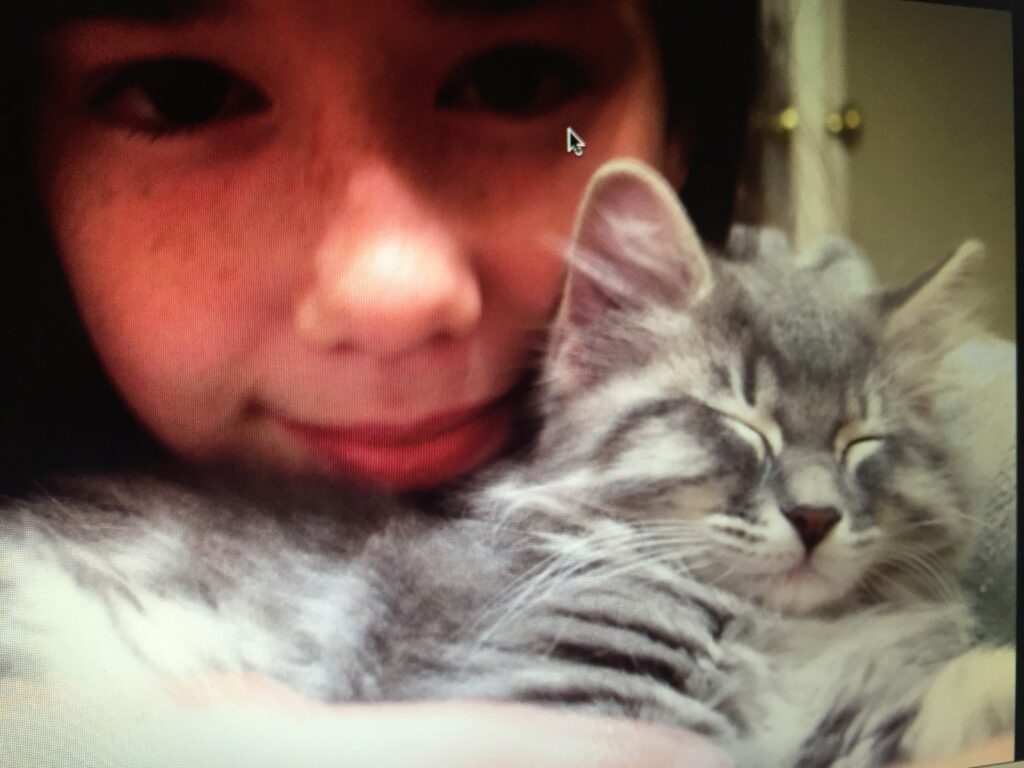
 I want you to imagine that the Dowager Countess from Downton Abbey smoked a pack a day and woke up one day as giant fluffy cat adopted by an 11 year old girl. You’ve now got a good idea of my child-to-adulthood cat. She was larger than life (literally and metaphorically) and she loved to be the center of attention. She was also, for lack of a more accurate term, a bitch (non-derogatory). I loved her with my whole soul. She loved me. And she was the queen of boundaries.
You’d like to play with her? She’ll allow it. You want her to sit on the couch with you? She’ll let you know if she’s available. You want to pick her up and dance with her around the house? She will remove herself from that situation faster than you can start your Barry Manilow impersonation.
Mandy may have had rules about what scritches she liked, but she couldn’t tell me. She could not tell me the rule that 3 belly rubs is the absolute limit I am allowed. She could honor her own limits and run away when I tried for a fourth. She could bop my hand when I didn’t respect her. She couldn’t set a rule about cuddles, but she could absolutely let me know when her boundary had been violated and what the consequences were for doing so.
Obviously this isn’t how human boundaries work, but I don’t think it’s far off. If I don’t want what someone is offering it is my job to express it. If they cannot hear me, it is my job to remove myself. It is mine to know my limits and mine to protect them.
 Mandy was my first embodied experience of seeing and respecting a boundary and feeling no less love on the other side of it.
At the time, I didn’t understand that I could set boundaries or limits and people would still care about me. In my pre-developed-prefrontal-cortex brain, I was sure that if I stopped picking up responsibility for everyone else’s feelings, then they would no longer feel good around me. And if that was true, then no one would like me. And if that was true, then I was fundamentally unlovable. Boundaries were selfish and selfish people did not have friends.
I was allowing myself to be the collateral damage of other’s negative emotions because I could not yet differentiate my own from theirs.
And yet…
Daily I disappointed Mandy. I was a human after all. But that was never a threat to our relationship.
My cat gave me the gift of embodied boundaries by showing me I was safe in relationships even if I upset the other party. Their boundary is theirs and the upset is theirs too. My violation is mine and the offer of repair is mine too. Neither owner picks up what belongs to the other, and none of these actions mean that love is not present.
Mandy died in 2023. We had 20 years together. She knew the teenage me who cried over my first heartbreak. She knew that 21 year old me who couldn’t imagine setting a boundary. She knew the therapist version of me who gets to teach boundaries. And she now has the privilege of being a metaphor I use with clients – because dogs may teach us unconditional love, but our cats teach us boundaries.
Carson McCain is an LPC at Dallas Therapy Collective, specializing in grief, disenfranchised grief, and complex trauma. She is EMDR trained and working toward EMDRIA certification.
Photos sourced from SMU Theatre, Nedra Glover Tawwab’s website, and the depths of my old facebook photodumps